Kaz at 22: What Two Decades of Building Software Taught Us About Everything
Updated: Sep 28

There is a particular kind of quiet confidence that only comes with time. Not arrogance. Not nostalgia. Just the settled certainty of a team that has been in the room long enough to know what the room looks like before the meeting even starts.
This month, Kaz Software turns 22.
We were founded in 2004 in Dhaka, at a time when "software company in Bangladesh" still drew skeptical pauses at dinner tables. Broadband was a rumor for most of the country. The iPhone did not exist. AI was an academic curiosity discussed in journals almost nobody read. And yet, here was a small team on Shantinagar, writing code for clients on the other side of the world, building something quietly, persistently, and without fanfare.
Twenty-two years later, we have 100+ people, 250+ projects, clients in 35+ countries, offices in Dhaka and Bern, and a Gold Award from the Best Asia Innovation Summit in Hong Kong. We have served refugee children in Cox's Bazar, farmers in the UK, furniture shoppers across Bangladesh, and manufacturing engineers in the United States. We have built systems that run in low-connectivity field environments, eCommerce platforms that serve 100,000+ users a month, and AI models that fly drones over crop fields and make real-time decisions about where to spray. But none of those numbers are the most interesting part of the story.
The Beginning: Writing Code When Bangladesh Wasn't on the Map
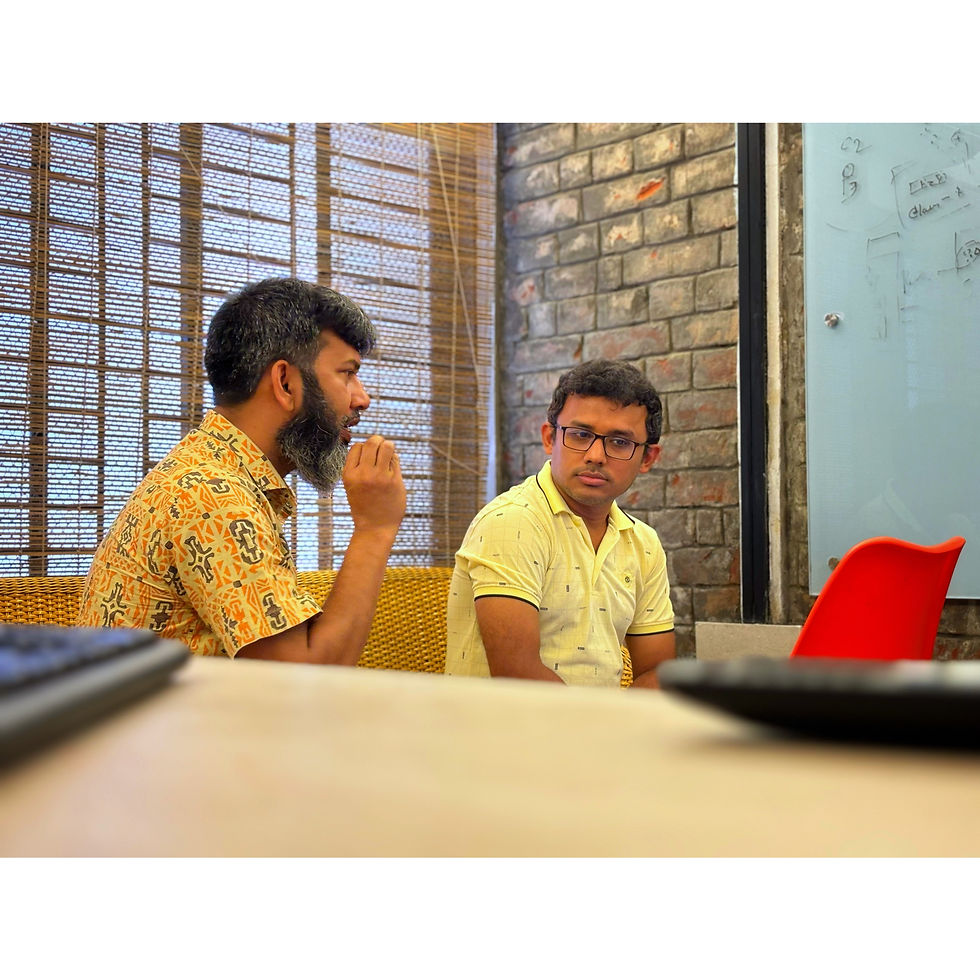
Kaz at 22: When Kaz opened its doors, the global software outsourcing conversation was almost entirely about India and Eastern Europe. Bangladesh was not part of that sentence. There were no industry benchmarks, no ecosystem playbook, and no blueprint for building a software firm here that foreign clients would trust with real, complex work.
What we had instead was an obsession with craft and a belief that if the code was good, the geography would eventually stop mattering. It did. Within a few years, we were delivering projects for Thomson Reuters, BlueCielo, Oxfam, and other international organizations who found that what Kaz lacked in name recognition, it more than compensated for in precision, communication, and a refusal to ship work that wasn't ready.
That founding discipline, quality over speed, transparency over comfort, ownership over excuses became the cultural DNA of the company. Every value we put on our website today was discovered, not invented. We learned it the hard way, through missed deadlines we fixed, through hard client conversations we didn't avoid, and through decisions to rebuild something properly instead of patching it.
Kaz at 22: Surviving Everything Since 2004
To say we have operated through "challenging times" is the kind of understatement that

only makes sense if you lived it. In our first decade, we navigated Bangladesh's infrastructure realities: unreliable power, limited connectivity, a talent market that had not yet caught up with the ambition of what we were trying to build. We invested heavily in training our own people when the market could not supply them.
Then came the global financial crisis. Then the steady disruption of cloud computing, which rewrote the rules of how software is built and deployed. Then COVID-19, a moment that tested every organization on Earth, and tested ours just as hard. Remote work was not a pivot for us. We had been managing global client relationships across time zones for fifteen years. But the human dimension of keeping a team cohesive, motivated, and mentally well through eighteen months of uncertainty that required a different kind of leadership altogether.
And then came AI. Not as a buzzword we appended to our services page. As something we genuinely had to reckon with as a capability, a shift in client expectations, and a new kind of engineering challenge. We had already been working on machine learning and computer vision projects before "AI" became the most searched term in business. When the wave arrived, we were not caught in the shallows.
The Work That Defines Us

The truest measure of a software company is not its headcount or its awards. It is the problems it has been trusted to solve. Here is a small window into ours.
One of Bangladesh's iconic consumer brands trusted Kaz to build and deliver their digital presence. The Polar website is a complete Kaz build, designed and engineered to serve a brand with real heritage in this market.
Bangladesh's leading furniture brand came to us with an ambitious challenge: unify the showroom and the smartphone into a single, seamless buying experience. We built their full omnichannel eCommerce ecosystem — web, mobile app, virtual room planner, 360° product views, inventory automation, and a custom CMS — entirely from scratch. The platform now serves over 100,000 monthly active users and has reduced manual order processing by 40%.
In the refugee settlements of Cox's Bazar, UNICEF needed a system capable of managing education delivery for tens of thousands of displaced adolescents. We built a full Education Management Information System that tracks 35,000+ students across 4,590+ learning institutions, integrates GIS mapping for coverage analysis, supports offline mobile data collection in low-connectivity zones, and delivers real-time dashboards to UNICEF staff, partners, and donors.
When one of the world's largest humanitarian organizations needed a single platform to unify four distinct aid programs serving Rohingya and host communities, they called us. We built a centralized MIS that brought Nabapallab, Bijoyee, CNHA, and DFAT IV under one system, improved program execution speed by 30%, and gave field teams real-time visibility — designed alongside humanitarian workers in Cox's Bazar, not from a boardroom.
A UK-based agricultural technology company wanted to turn drones into autonomous crop doctors. We built an AI-powered precision agriculture platform that analyzes live drone footage in real time, detects disease across multiple crop types using machine learning, maps infected zones via GPS, and automates targeted pesticide spraying — delivering up to 70% pesticide reduction and saving over 5,000 labor hours.
Beyond these, Aarong — Bangladesh's most beloved lifestyle brand — has trusted us with their digital work. And globally, organizations like UNESCO and P1ston represent what Kaz looks like when it operates at the intersection of technology, impact, and industrial scale.
What a Client of 12 Years Said
"I have partnered with Kaz for over 12+ years. They are my go-to for good reason. Quality code, cost-effective, easy to work with."
— PJ Bellomo, P1ston Inc.
Twelve years. In an industry where vendor relationships often last twelve months, that sentence is its own testament.
The People Are the Company
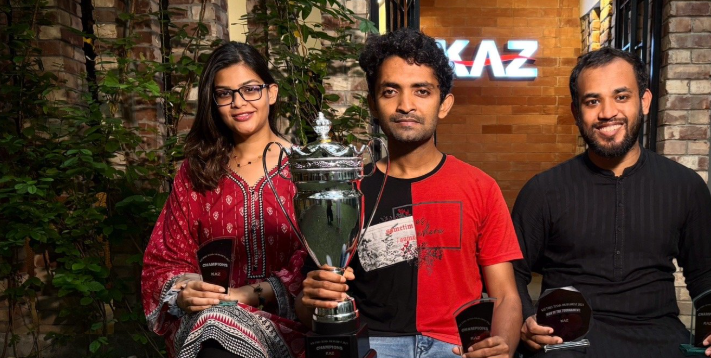
None of this work exists without the people who built it. Kaz has always been at its core a people company wearing a technology company's clothes. Ninety percent of our team holds a BS, MSc, or MBA. Seventy percent are senior or mid-level specialists. Thirty-five percent have been with us for five or more years a retention number that is genuinely unusual in this industry, and one we do not take for granted. Our culture is built around six values we did not make up in a strategy session. We discovered them over time: Client First. Own the Outcome. Be Bold. Respect the Craft. Win Together. People at the Core. Each one is traceable to a real moment in our history a decision made under pressure, a conversation that was difficult to have, a project that required everyone to give more than was comfortable. We invest in our people because we believe retention of talent is the most underrated competitive advantage in software. When a developer has been with a team for four years, their output is qualitatively different. They understand systems, relationships, and context in ways that cannot be onboarded. That institutional knowledge is one of the most valuable things Kaz has built over 22 years and it lives in our people. We also try to build a workplace that does not take itself too seriously. The team events, the celebrations, the moments of genuine laughter across floors and disciplines these are not perks bolted onto a serious business. They are part of how a serious business stays healthy over two decades.
The Alumni Effect
One of the less-told parts of the Kaz story is what happens after people leave.
Not everyone stays. Some of our best engineers graduate from Kaz and go on to write code or lead engineering teams at companies like Meta, Google, Amazon, JPMorgan, Bloomberg, Wells Fargo, and LinkedIn. We consider this a source of genuine pride, not loss. Kaz alumni carry a standard of craft, communication, and professionalism that represents this company in rooms around the world. For clients who engage us on staff augmentation, this network is part of what they are accessing. When you work with Kaz, you are working with a talent pipeline that has been building, testing, and shipping real software since before most of today's frameworks existed.
Tell us your needs, and our pre-vetted experts are ready to start.
On AI, and What It Actually Means for Us
We want to be direct about something. AI is not a feature we added to stay relevant. It is a genuine shift in how software is built, what it can do, and what clients now expect. We have been doing applied machine learning computer vision, NLP, predictive modeling for years. The Virus Shield drone platform is not a demo. The UNESCO AI work is not a proof of concept. These are production systems in the world. At the same time, we are honest about what AI is and is not. It is not magic. It requires good data, careful engineering, rigorous testing, and human judgment about where automation should and should not make decisions. We approach it the same way we approach everything else we build: with craft, transparency, and a long-term view. What the AI era has confirmed for us is that the companies who will thrive are not the ones who adopted AI fastest. They are the ones who knew enough about software deeply, fundamentally to understand what AI could do and integrate it with judgment. Twenty-two years of building software in the real world is a meaningful foundation for that.
From Foreign-Only to Truly Global and Local
For much of our early history, Kaz operated almost exclusively for international clients. This was partly a market reality Bangladesh's domestic software industry was nascent and partly a strategic choice that forced us to meet global standards from day one.
Over time, that calculus shifted. Bangladesh grew. The appetite for serious, well-engineered digital products among domestic businesses became real. Brands like HATIL, Aarong, and Polar began to see software not as a cost center but as a competitive edge and they needed a partner who could deliver at a global standard.
Today, Kaz serves both worlds. We bring the same engineering standards, the same communication practices, and the same commitment to outcomes whether the client is in Dhaka or Denver. That dual perspective rooted here, credible globally is not something many firms can honestly claim.
What Twenty-Two Years Taught Us
If we were to distill 22 years into a few honest sentences:
Good software is not about technology. It is about understanding the problem well enough that the technology becomes obvious. The teams that last are the ones that learn to have the uncomfortable conversation early, before it becomes expensive. Craft compounds. A codebase maintained with care over five years becomes an asset. One maintained carelessly becomes a liability that shadows every future decision. Trust is the only thing that cannot be accelerated. It has to be earned in the small moments the update no one asked for, the risk flagged before it became a crisis, the timeline held not because the contract required it but because the team's reputation required it.
And finally: the best reason to still be here after 22 years is not the revenue, the awards, or the name recognition in new markets. It is that there are still problems worth solving.
We Are Just Getting Started
Twenty-two is not an endpoint. It is, if we are honest about it, still early. The problems ahead in healthcare, in agriculture, in education, in humanitarian response, in manufacturing, in the infrastructure of daily life are larger and more technically demanding than the ones we have already solved. We are positioned for them in a way we were not a decade ago. If you are a business with a software challenge that has resisted easy answers, we would like to talk. If you are a developer or engineer looking for a team that takes craft seriously, we are hiring. And if you are one of the clients, partners, or team members who have been part of this story in any chapter thank you. You are the reason there is a story to tell. Here is to 22 years. And to what comes next.